

Virtual Reality and AR in Medical Training and Therapy: Uses, Benefits, and Limitations
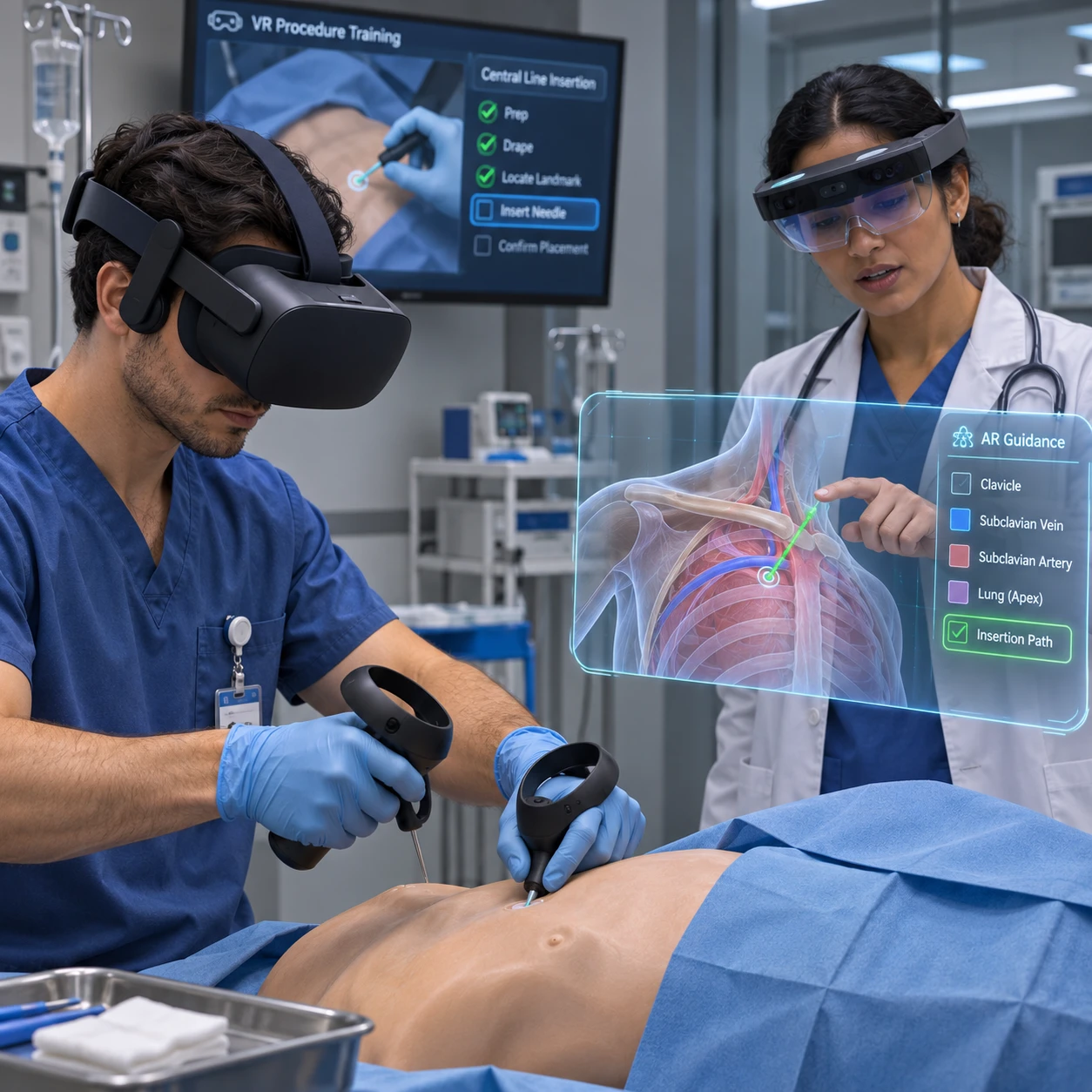
Virtual reality (VR) and augmented reality (AR) are changing how clinicians learn and how some patients practice therapeutic activities. These immersive technologies can create controlled scenarios for medical simulation, add digital guidance to real-world tasks, or help deliver structured rehabilitation and exposure therapy.
Their value depends on the use case, the quality of the software, and the people using it. VR and AR can complement clinical teaching and care, but they do not replace supervised experience, professional judgment, or evidence that a tool improves patient outcomes.
VR and AR in healthcare: What’s the difference?
VR replaces the user’s view of the surroundings with a computer-generated environment; AR overlays digital information on the real world. In healthcare, VR is often used for immersive simulation or therapy, while AR can provide visual guidance during a real task.
A VR headset can place a medical trainee in a simulated operating room or let a patient practice balance exercises in a virtual setting. The user typically sees and interacts with a digital scene, although the level of realism and interaction varies by system.
AR uses a camera, display, or headset to show digital elements alongside the physical environment. For example, an AR application might display a three-dimensional anatomical model for teaching or show visual prompts during a skills exercise. The clinician can still see the room and the person in front of them.
Neither label guarantees clinical value. A convincing visual experience may still provide weak instruction, and an AR overlay may distract if it is poorly placed or difficult to read. The useful distinction is practical: VR creates a separate practice environment; AR adds information to the environment already in view.
How immersive technology supports medical training
Immersive technology supports medical training by letting learners rehearse clinical skills and decisions in structured, repeatable scenarios. Medical simulation can cover tasks from patient assessment to procedural steps, with opportunities to pause, repeat, and review performance.
In surgical training, a VR simulator may let a learner practice instrument handling or a sequence of procedural actions without involving a patient. Simulation can also present changing conditions, requiring learners to recognize findings, choose a response, and communicate with a team. AR may be useful in anatomy education or when digital guidance is needed during a supervised practice task.
Good training design connects the simulation to a specific learning objective. For example, a course might assess whether a learner follows a defined sequence, identifies a critical error, or completes a task within an appropriate level of accuracy. Feedback should explain what happened and how to improve, rather than simply assigning a score.
These tools are best treated as one part of a broader curriculum. They cannot fully reproduce patient variation, tactile feedback, communication, or the pressures of real clinical care. Learners still need instruction, supervised practice, and assessment in appropriate clinical settings. A simulator can help prepare someone for those experiences; it cannot certify competence on its own.
Applications in therapy and rehabilitation
VR and AR can support rehabilitation exercises and clinician-guided exposure therapy by creating structured tasks or controlled virtual situations. Whether they suit a particular patient depends on clinical goals, symptoms, preferences, and access needs.
In rehabilitation, VR may turn repeated movements into guided tasks, such as reaching toward virtual objects or following a balance activity. The system can provide visual cues and record performance measures, which may help a clinician adjust difficulty. AR can add prompts to exercises performed in the patient’s actual surroundings, potentially keeping the activity connected to everyday movement.
Exposure therapy may use VR to present a feared situation in a controlled, adjustable way under a qualified clinician’s care. A person might encounter a virtual scenario gradually, while the therapist monitors distress and helps them use treatment strategies. This is not appropriate for every person or condition, and a digital environment should not be treated as a substitute for individualized assessment or professional therapy.
Clinicians should consider motion sensitivity, vision or hearing needs, mobility, cognitive load, and the possibility of discomfort or distress. Patients should be able to pause or stop an activity. The technology should support a care plan, with a clinician deciding when to progress, modify, or discontinue it.
Potential benefits for learners and patients
VR and AR can make practice repeatable, interactive, and easier to structure. These features may help learners or patients focus on a specific task, but they do not by themselves prove better learning or health outcomes.
In medical training, a learner can repeat a scenario without using clinical resources each time. A controlled simulation can also make it easier to review the same decision point across attempts. For therapy, adjustable activities may allow a clinician to tailor a task’s pace or complexity and observe how a patient responds.
Feedback is most useful when it is clear and tied to the goal. A surgical training tool, for instance, might show where a learner’s actions departed from an expected sequence. A rehabilitation program might track a movement measure selected by the treating team. In both cases, the data needs context: a score is only meaningful if it reflects a relevant skill or clinical objective.
Potential benefits should be separated from established outcomes. A system may be engaging yet fail to improve retention, transfer to real clinical work, or patient function. Teams should ask what changed, for whom, and compared with what alternative. Engagement is a design feature; patient outcomes and demonstrated competence are the results that matter.
Limitations and implementation challenges
VR and AR implementation can be limited by cost, access, usability, safety, and the work required to maintain clinical content. A pilot needs more than a headset: it also needs a defined purpose, staff support, suitable space, and a plan for evaluating outcomes.
Hardware and software costs can include devices, licensing, updates, cleaning supplies, technical support, and staff training. Content must be accurate and appropriate for the intended learners or patients. Clinical teams should check who created it, how often it is reviewed, and whether it matches local procedures and current practice.
Access is another concern. Headsets may not fit every user comfortably, and visual, hearing, mobility, or cognitive needs can affect usability. Some people experience eye strain, nausea, dizziness, or discomfort during immersive sessions. AR can also add clutter or distract from the real task if information appears at the wrong time or in the wrong place.
Workflow matters. A tool that requires lengthy setup or creates extra documentation may be difficult to sustain in a busy clinic. Patient safety needs clear safeguards, including supervision where appropriate, a way to stop the experience, and a process for responding to discomfort or technical failure. Choosing immersion for realism may mean accepting more equipment, support, and safety demands.
Evaluating effectiveness and choosing an approach
Choose VR or AR by starting with the intended clinical or learning outcome, then evaluate effectiveness, usability, and safety in the population that will use it. The right technology is the one that fits the task and produces meaningful results, not the one with the most immersive display.
A practical selection process has four checks:
- Define the task: Specify the skill, decision, movement, or therapeutic goal the system should support.
- Match the format: Use VR when a separate, controlled environment is useful; consider AR when digital guidance should sit alongside a real-world task.
- Check fit and risk: Test comfort, accessibility, clinical accuracy, workflow demands, privacy, and procedures for stopping or adapting a session.
- Measure the result: Select outcome measures before rollout, such as skill performance, retention, transfer to supervised practice, functional change, adverse effects, or patient-reported experience.
Where possible, compare the immersive approach with current practice or another suitable teaching or treatment method. Include the staff time and ongoing costs in the assessment, not only the purchase price. A small, supervised pilot can reveal practical problems before wider adoption, but results from one population or setting should not automatically be generalized to another.
Frequently asked questions
What is the difference between VR and AR in healthcare?
VR places the user in a computer-generated environment, while AR adds digital information to the real-world view. VR is commonly used for simulation or controlled therapy scenarios; AR can support teaching or tasks where clinicians need to see their surroundings.
Can VR replace hands-on medical training?
No. VR can provide repeatable practice and feedback, but it does not fully reproduce patient care, tactile experience, communication, or supervised clinical judgment. It should complement, not replace, hands-on training and assessment.
How is VR used in rehabilitation or exposure therapy?
VR can present guided rehabilitation tasks or controlled scenarios for clinician-supervised exposure therapy. A qualified professional should decide whether the approach suits the patient, monitor the response, and adapt or stop the session when needed.
What are the main limitations of VR and AR in healthcare?
Common limitations include equipment and maintenance costs, accessibility barriers, discomfort, technical problems, workflow demands, and concerns about content quality and safety. Their effect on learning or patient outcomes also needs to be evaluated rather than assumed.